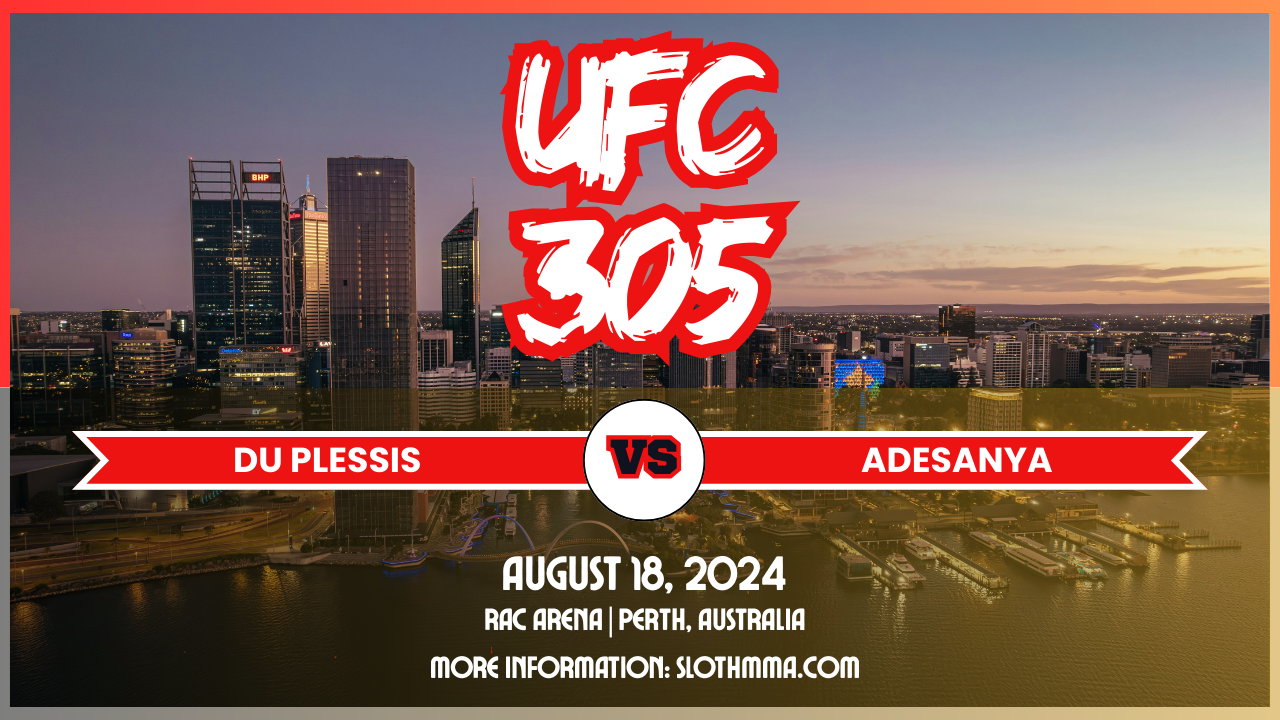

The UFC returned to Australia with one of the most anticipated events of 2024, as UFC 305: Du Plessis vs Adesanya took place at RAC Arena in Perth, Western Australia on August 18, 2024 (local time, August 17 in North America). The pay-per-view spectacular featured a highly personal middleweight championship grudge match between current champion Dricus "Stillknocks" Du Plessis and former two-time titleholder Israel "The Last Stylebender" Adesanya. This historic event marked the first time two African-born athletes competed for a UFC title, adding cultural significance to an already heated rivalry built on months of verbal warfare and perceived disrespect.
The event represented the UFC's third visit to Perth and first since UFC 284 in February 2023, while also marking the beginning of a multi-year deal for twice-annual events in the Western Australian capital. The 12-fight card delivered exceptional value for the sold-out crowd of 14,152 fans, generating a gate of $5,477,097 USD and setting records as the highest-grossing event in RAC Arena history.
From dramatic knockouts to controversial submissions and split decision wars, UFC 305 showcased the depth of talent on the UFC roster and provided fight fans around the world with memorable moments that will be discussed for years to come.
Table of Contents
Main Card - UFC 305: Du Plessis vs Adesanya
Dricus Du Plessis (South Africa) defeats Israel Adesanya (Nigeria/New Zealand) via Submission (Rear-Naked Choke) at 3:38 of Round 4 to retain UFC Middleweight Championship
In a dramatic culmination to one of the UFC's most bitter rivalries, South African champion Dricus Du Plessis successfully defended his middleweight title by submitting Israel Adesanya in the fourth round of their championship bout. The 30-year-old Du Plessis improved to 22-2 overall and extended his UFC winning streak to nine consecutive victories, while the 35-year-old Adesanya dropped to 24-4 and suffered his second consecutive defeat, raising serious questions about his future in the sport.
The fight began cautiously as both men showed mutual respect despite months of inflammatory pre-fight rhetoric. The first round was competitive and close, with both fighters landing quality strikes but neither man establishing clear dominance. Du Plessis demonstrated improved striking fundamentals while Adesanya showed flashes of the technical brilliance that made him a two-time champion.
The second round saw a significant shift as Du Plessis successfully implemented his wrestling game. "Stillknocks" secured multiple takedowns and attempted submissions from dominant positions, nearly locking in a rear-naked choke that foreshadowed the fight's eventual ending. Adesanya's defensive grappling—long considered a weakness—was exposed as he struggled to prevent the takedowns and escape bad positions once on the canvas.
Adesanya mounted a comeback in the third round, finding success with brutal body kicks and combination punching that visibly hurt Du Plessis. "The Last Stylebender" targeted the South African's liver, ribs, and kidneys with ruthless precision, attacking the body with every kick and punch combination. The accumulated damage appeared to slow Du Plessis significantly, draining his cardio and giving Adesanya momentum heading into the championship rounds.
The fourth round began with Adesanya continuing his body attack, landing hard uppercuts and leg kicks while Du Plessis appeared fatigued. However, in a stunning turn of events, Du Plessis connected with a powerful left hand that clearly hurt Adesanya midway through the round. Sensing opportunity, the champion unleashed a combination of three consecutive right hands that further compromised the challenger.
With Adesanya visibly rocked, Du Plessis shot for a takedown and secured Adesanya's back as the former champion attempted to defend. Du Plessis locked in the rear-naked choke with textbook technique, securing both hooks and applying maximum pressure. Adesanya, unable to defend the fully locked submission, was forced to tap out at 3:38 of the fourth round, giving Du Plessis his first successful title defense.
The finish demonstrated Du Plessis' remarkable toughness and championship mentality. Despite absorbing brutal body shots that would have folded most fighters, the South African maintained offensive pressure and never stopped hunting for the finish. His inhuman durability, combined with his improving striking and dangerous grappling, makes him a difficult puzzle for any middleweight to solve.
In a touching post-fight scene, both fighters showed mutual respect, embracing after their interviews and seemingly putting their bitter feud to rest. Du Plessis was highly complimentary of Adesanya in his post-fight interview, acknowledging his opponent's skill and legacy. For Adesanya, the loss was devastating—his second straight after losing the title to Sean Strickland at UFC 297. In an emotional post-fight speech channeling Leonardo DiCaprio in "The Wolf of Wall Street," Adesanya declared he wasn't leaving the sport despite not knowing what his future holds.
The victory positions Du Plessis as the undisputed top middleweight in the world. Former champion and current light heavyweight titleholder Alex Pereira immediately called for a return to 185 pounds to challenge Du Plessis, posting on social media that he's "coming down to 185 one more time," setting up a potential blockbuster superfight.
Kai Kara-France (New Zealand) defeats Steve Erceg (Australia) via TKO (Punches) at 4:04 of Round 1 - Performance of the Night
In a stunning upset that shook the flyweight division, New Zealand's Kai "Astroboy" Kara-France demolished hometown fighter Steve Erceg with a first-round knockout, earning a $50,000 Performance of the Night bonus. The 31-year-old Kara-France improved to 25-11 overall and 8-4 in the UFC, while the 28-year-old Erceg suffered his first knockout loss, dropping to 12-3 overall and 3-2 in the UFC.
The fight began with Erceg finding early success with his jab, using his reach advantage to touch Kara-France from distance. The Perth native appeared comfortable in the early exchanges, boxing effectively from the outside as the shorter Kara-France struggled to close distance. However, Erceg made a critical tactical error that would prove costly.
As the taller fighter, Erceg began punching downward at the stocky Kara-France, angling his shots toward the New Zealander's chin. This technique left Erceg's own chin exposed, as punching downward prevented him from maintaining proper defensive positioning. Kara-France, a proven finisher with knockout power, recognized the opening and began loading up on big overhand shots aimed upward at Erceg's chin.
The dramatic finish came suddenly. Kara-France landed a massive overhand right that caught Erceg clean on the chin, immediately dropping the Australian to the canvas. Showing excellent killer instinct, Kara-France swarmed with follow-up punches, landing several more clean shots to the downed Erceg. Referee Steve Perceval stepped in to halt the contest at 4:04 of the opening round, giving Kara-France a statement victory.
The knockout was particularly significant given the context. Just months earlier, Erceg had challenged Alexandre Pantoja for the flyweight title at UFC 301, losing a close split decision that many observers felt he deserved to win. Erceg was one round away from potentially being world champion, making his devastating knockout loss all the more shocking.
For Kara-France, the victory represented a triumphant return after a difficult period. The win marked his first victory since March 2022, snapping a frustrating two-fight losing streak. The emotional New Zealander had contemplated retirement during his time away from the Octagon, making the spectacular finish even more meaningful.
In his post-fight interview, Kara-France made his intentions clear, calling for an immediate title shot. The former interim title challenger believes his knockout of a recent title challenger warrants placement at the front of the flyweight championship queue. With champion Alexandre Pantoja looking for fresh challengers and Kara-France now riding momentum from a highlight-reel finish, a title shot could materialize in 2025.
Dan Hooker (New Zealand) defeats Mateusz Gamrot (Poland) via Split Decision (29-28, 28-29, 29-28) - Fight of the Night
In an absolute war that earned both fighters $50,000 Fight of the Night bonuses, New Zealand's Dan "The Hangman" Hooker edged Polish grappling ace Mateusz Gamrot in a closely contested three-round battle. The 34-year-old Hooker improved to 24-12 overall, while the 34-year-old Gamrot dropped to 25-3 overall and 8-3 in the UFC in a fight that could have gone either way.
The lightweight clash showcased a classic striker versus grappler matchup, with Hooker's rangy striking and powerful punches battling against Gamrot's relentless wrestling and submission attempts. The Polish fighter came out aggressively in the first round, landing solid shots on the feet before attempting to implement his wrestling game. However, Hooker defended brilliantly, using guillotine choke attempts as both offensive weapons and takedown defense, forcing Gamrot to abandon several shooting attempts or risk being submitted.
When Gamrot did secure takedowns, Hooker displayed excellent defensive grappling, working back to his feet and landing the bigger, more impactful strikes. Late in the first round, Hooker connected with a powerful shot that wobbled Gamrot, giving the New Zealander a strong finish to the frame.
The second round was the most competitive, with both men having moments of success. Hooker continued landing the heavier strikes from distance, using his reach advantage to control the center of the Octagon. Gamrot finally secured a meaningful takedown midway through the round, but Hooker quickly scrambled back to his feet, refusing to allow the Polish wrestler to establish prolonged control. The round appeared to be a toss-up on the scorecards, with arguments for either fighter.
The third round saw both men empty their tanks in pursuit of victory. Gamrot, knowing he likely needed a finish or dominant round, pressed forward with combinations and takedown attempts. Hooker, displaying the championship heart that has defined his career, met fire with fire, stuffing most of Gamrot's wrestling attempts while landing clean counters. In several exchanges, Hooker even managed to drop or stagger Gamrot with big shots, though the durable Polish fighter recovered each time.
When the final horn sounded, both fighters had legitimate claims to victory. The judges split on the decision, with two scoring it 29-28 for Hooker and one seeing it 28-29 for Gamrot (equivalent to 29-28 for Gamrot). The split decision reflected how competitive the fight was, with neither man establishing clear dominance.
For Hooker, the victory was massive. The City Kickboxing product earned his first Fight of the Night bonus since 2020 and moved into title contention in the ultra-competitive lightweight division. The win also marked a successful evening for New Zealand fighters, as Hooker joined gym mate Kara-France in securing impressive victories in front of a partisan Australian crowd.
For Gamrot, the loss was devastating. The top-five ranked lightweight had entered as a significant betting favorite and was expected to use his superior wrestling to dominate Hooker. Instead, his takedowns were largely neutralized, and he found himself out-struck by the rangier, more technical striker. The defeat potentially sets Gamrot back significantly in the lightweight title picture.
Jairzinho Rozenstruik (Suriname) defeats Tai Tuivasa (Australia) via Split Decision (29-28, 27-30, 30-27)
In a heavyweight bout marred by controversy both inside and outside the Octagon, Surinamese knockout artist Jairzinho "Bigi Boy" Rozenstruik earned a split decision victory over Australian fan favorite Tai "Bam Bam" Tuivasa. The 36-year-old Rozenstruik improved to 15-5 overall, while the 31-year-old Tuivasa extended his losing streak to five consecutive defeats, dropping to 15-8 overall and potentially facing release from the UFC.
From the opening bell, Rozenstruik implemented a disciplined game plan focused on technical kickboxing. The former Glory kickboxing contender worked behind his superior jab, maintaining distance and picking Tuivasa apart from range. "Bigi Boy" remained patient, refusing to engage in the brawling exchanges that might favor Tuivasa's devastating knockout power.
Tuivasa, fighting in front of his home country crowd, struggled to close distance effectively. The Sydney native landed some quality shots when he managed to get inside, but Rozenstruik's footwork and cage generalship kept those moments to a minimum. Throughout the 15-minute contest, Rozenstruik significantly out-landed Tuivasa, connecting with sharp jabs, straight punches, and leg kicks that accumulated damage.
In the brief moments where Rozenstruik hurt Tuivasa, the Surinamese fighter showed restraint, opening up with combinations but never overcommitting and leaving himself vulnerable to Tuivasa's legendary counter-punching power. The tactical approach proved effective, as Rozenstruik controlled the majority of the fight without taking significant damage himself.
When the scorecards were read, controversy erupted. Two judges scored the fight 29-28 and 30-27 for Rozenstruik, while one judge scored it 27-30 for Tuivasa (equivalent to 30-27 for Tuivasa). The 30-27 scorecard for Tuivasa, rendered by judge Howie Booth, drew immediate criticism from fans and media alike. Booth's scoring suggested he believed Tuivasa clearly won all three rounds despite the Australian's low output and inability to land clean strikes consistently.
The controversial scorecard was deemed so egregious that UFC officials took the unprecedented step of removing Booth from judging duties for the remainder of the event. He was not assigned to judge the subsequent co-main event between Kara-France and Erceg, a clear indication that his scoring was considered unacceptable.
For Rozenstruik, the victory snapped a two-fight losing streak and kept him relevant in the heavyweight division. For Tuivasa, the loss was catastrophic—his fifth consecutive defeat dating back to losses against Sergei Pavlovich, Marcin Tybura, Alexander Volkov, and Ciryl Gane. At 31 years old with significant mileage on his body and a troubling pattern of absorbing heavy damage, Tuivasa likely faces the most uncertain period of his UFC career. Many observers expect the promotion to release the popular Australian if he suffers another defeat.
Carlos Prates (Brazil) defeats Li Jingliang (China) via KO (Left Hook) at 4:02 of Round 2 - Performance of the Night
Brazilian welterweight prospect Carlos "The Nightmare" Prates made history with one of the most spectacular knockouts of 2024, becoming the first fighter ever to knock out Chinese veteran Li "The Leech" Jingliang, earning a $50,000 Performance of the Night bonus in the process. The 31-year-old Prates improved to an impressive 20-6 overall and 3-0 in the UFC, while the 36-year-old Li dropped to 19-9 overall and 11-7 in the UFC.
The fight showcased Prates' dangerous striking from the opening bell. The Brazilian immediately established his range and began finding success with his varied attack, mixing punches and kicks to all levels. Jingliang, known for his iron chin and brawling style, attempted to pressure Prates and drag him into a firefight, but "The Nightmare" maintained his composure and picked his shots carefully.
Throughout the first round and into the second, Prates systematically broke down Jingliang with technical striking. He landed clean combinations, repeatedly staggering the Chinese veteran with power shots while avoiding Jingliang's counters. The accumulated damage was visible on Jingliang's face as the second round progressed, but the notoriously durable fighter refused to wilt.
Then came the finish. Late in the second round, Prates landed a perfectly timed left hook that caught Jingliang flush on the chin. The shot was devastating—Jingliang's eyes rolled back as he fell face-first to the canvas, completely unconscious before hitting the mat. The referee immediately waved off the fight at 4:02 of round two, with Jingliang out in a major, major way.
The knockout was significant for multiple reasons. Jingliang had never been knocked out in his entire 19-fight UFC career, absorbing heavy shots from some of the division's hardest hitters without being finished. Prates' ability to accomplish what elite welterweights like Khamzat Chimaev, Neil Magny, and Muslim Salikhov could not demonstrated his exceptional knockout power.
The victory extended Prates' winning streak to ten consecutive fights and positioned him as one of the most exciting prospects in the welterweight division. In his post-fight interview, Prates called for a step up in competition, targeting a ranked opponent to continue his rapid ascent through the 170-pound rankings. With three spectacular finishes in three UFC appearances—all in his rookie year—Prates appears destined for a top-15 ranking and potentially a number next to his name by 2025.
The Prelims - UFC 305: Du Plessis vs Adesanya
Valter Walker (Brazil) defeats Junior Tafa (New Zealand/Australia) via Technical Submission (Heel Hook) at 4:56 of Round 1
In a controversial heavyweight bout that ended in drama, Brazilian grappler Valter Walker submitted Samoan-New Zealander Junior Tafa with a heel hook in the final seconds of the first round. The 27-year-old Walker improved to 12-1 overall and 1-0 in the UFC, while the 29-year-old Tafa dropped to 5-3 overall and 2-3 in the UFC.
Walker, the younger brother of UFC veteran Johnny Walker, wasted no time implementing his grappling game. The Brazilian secured an early takedown and worked methodically to isolate Tafa's leg. With his superior grappling credentials, Walker transitioned smoothly into position for the heel hook, a devastating leg lock that attacks the ankle, heel, and knee simultaneously.
Despite Tafa's best defensive efforts, Walker secured the submission with perfect technique. Referee Steve Perceval stopped the contest at 4:56 of the opening round when it appeared Tafa was in danger of serious injury. However, controversy immediately erupted.
Tafa and his corner believed he was never in real danger and that the stoppage was premature. The Samoan heavyweight confronted Walker immediately after the fight, slapping him across the face in frustration. While such conduct typically results in fines or suspensions, Tafa's emotional reaction highlighted his genuine belief that the referee had intervened too early.
The finish marked a successful UFC debut for Walker, who joined his brother Johnny as a victorious UFC fighter. The submission victory showcased the effectiveness of elite grappling at heavyweight, where such technical finishes are relatively rare compared to lower weight classes.
For Tafa, the controversial loss was frustrating, particularly given that he was fighting on home soil (New Zealand/Australia) and had prepared extensively for Walker's grappling. The defeat put Tafa in a precarious position with a 2-3 UFC record and back-to-back losses.
Ricardo Ramos (Brazil) defeats Joshua Culibao (Australia) via Split Decision (29-28, 28-29, 29-28)
In a competitive featherweight battle, Brazilian grappler Ricardo Ramos edged hometown favorite Joshua Culibao via split decision, snapping a two-fight losing streak. The 29-year-old Ramos improved to 17-6 overall and 9-6 in the UFC, while the 31-year-old Culibao dropped to 11-4-1 overall and 3-3-1 in the UFC.
The fight began disastrously for Culibao when he slipped early in the first round while throwing a low kick. Ramos immediately capitalized, taking Culibao's back and threatening with deep choke attempts. The Brazilian nearly finished the fight multiple times with rear-naked choke attempts, but Culibao displayed remarkable defensive grappling and mental toughness, surviving the round despite being in dire straits.
The Australian rebounded strongly in the second round, keeping the fight standing and using his striking to control distance. Culibao landed sharp leg kicks and crisp boxing combinations, clearly winning the round on the feet and grabbing momentum heading into the final frame.
The third round was closely contested, with both men having moments of success. Culibao controlled the early portions on the feet, landing clean strikes and moving well. However, Ramos secured a late takedown and finished the round in top position, landing ground strikes and attempting submissions. The strong finish likely swayed at least one judge in the Brazilian's favor.
When the scorecards were read, the decision was split. Two judges scored it 29-28 for Ramos, while one saw it 28-29 for Culibao (equivalent to 29-28 for Culibao). The decision left Culibao visibly frustrated, as the Australian clearly felt he had done enough to win, particularly given that he was fighting at home and had survived the dangerous first round.
The victory was crucial for Ramos, who had been riding a two-fight losing streak and needed a win to stay relevant in the deep featherweight division. For Culibao, the split decision loss was disappointing but not devastating, as his competitive performance showed he belongs at the UFC level.
Casey O'Neill (Scotland/Australia) defeats Luana Santos (Brazil) via Unanimous Decision (30-27, 30-27, 30-26)
Returning to her adopted home of Australia, Scottish-Australian flyweight Casey O'Neill snapped her two-fight losing streak with a dominant unanimous decision victory over Brazil's Luana Santos. The 27-year-old O'Neill improved to 10-2 overall and 5-2 in the UFC, while the 33-year-old Santos dropped to 8-3 overall and 4-3 in the UFC.
From the opening bell, the ranked flyweight O'Neill dictated the terms of engagement, keeping Santos on the back foot and landing a steady diet of strikes throughout the 15-minute contest. O'Neill's superior activity level and effective striking were evident in every round, as she outlanded Santos with volume and precision.
Santos attempted to implement her grappling game, shooting for takedowns to neutralize O'Neill's striking advantage. However, O'Neill defended the takedown attempts with relative ease, using superior wrestling defense to keep the fight in her preferred range. When Santos did manage to close distance, O'Neill quickly broke free and returned to open space where she thrived.
O'Neill's striking was varied and effective, mixing jabs, straight punches, leg kicks, and occasional spinning attacks to keep Santos guessing. The Australian fighter never allowed Santos to establish rhythm or mount sustained offense, dominating position and controlling the cage throughout.
All three judges scored the fight decisively for O'Neill, with two seeing it 30-27 and one scoring it 30-26, a near-shutout. The lopsided scorecards reflected O'Neill's clear dominance in every facet of the fight.
The victory was significant for O'Neill, who had entered on a worrying two-fight skid following losses to Jennifer Maia and Ariane Lipski. By returning to the win column in dominant fashion, O'Neill positioned herself for a potential ranked opponent in her next outing and demonstrated that her previous losses were temporary setbacks rather than a permanent decline.
Jack Jenkins (Australia) defeats Herbert Burns (Brazil) via TKO (Leg Kicks) at 0:48 of Round 3
Australian featherweight Jack Jenkins made a triumphant return after nearly a year away from the Octagon, stopping Brazilian veteran Herbert Burns with accumulated leg kick damage in the third round. The Dana White's Contender Series alumnus improved to 13-3 overall and 4-1 in the UFC, while the 35-year-old Burns dropped to 14-7 overall and 6-5 in the UFC.
Jenkins had been sidelined for approximately one year after suffering an arm injury in his previous fight. The lengthy layoff raised questions about whether he would show any ring rust or physical limitations upon his return. Those questions were answered definitively—Jenkins looked sharp, powerful, and confident throughout the contest.
From the first round, Jenkins implemented a punishing leg kick strategy, targeting Burns' lead leg with heavy kicks that accumulated damage over time. The Brazilian attempted to counter with his grappling and submission game, but Jenkins' improved takedown defense kept the fight primarily standing where his striking advantage was most pronounced.
As the fight progressed into the second and third rounds, the cumulative damage to Burns' leg became increasingly evident. The Brazilian's mobility deteriorated significantly, compromising his ability to defend strikes, shoot for takedowns, or establish effective offense. Burns soldiered on gamely, showing the toughness that has defined his career, but the leg damage was insurmountable.
Less than a minute into the third round, Burns verbally indicated to the referee that he could no longer continue. Unable to put weight on his badly damaged leg, Burns retired on his stool, giving Jenkins the TKO victory at 0:48 of round three. The retirement stoppage was a rare occurrence in the UFC, highlighting just how devastating Jenkins' leg kicks had been.
The victory marked an impressive return for Jenkins, who proved that his year-long layoff had not diminished his skills or power. The Australian's leg kick game had clearly improved during his time away, and his ability to systematically break down a crafty veteran like Burns demonstrated his continued evolution as a fighter.
The Early Prelims - UFC 305: Du Plessis vs Adesanya
Tom Nolan (Australia) defeats Alex Reyes (USA) via Unanimous Decision (30-27, 30-27, 29-28)
Australian lightweight prospect Tom "Big Train" Nolan earned his second consecutive victory with a unanimous decision over American veteran Alex Reyes. The 24-year-old Nolan improved to 8-1 overall and 2-1 in the UFC, while the 32-year-old Reyes dropped to 13-9 overall and 1-3 in the UFC.
The fight began poorly for Nolan when he absorbed an illegal knee in the first round while in a grounded position. The foul disrupted the Australian's rhythm and appeared to give Reyes momentum early. However, Nolan regrouped and began implementing his game plan effectively in the second round.
The tall, rangy lightweight used his length advantage to control distance, working behind a stiff jab and landing straight punches down the middle. Nolan's activity level increased significantly as the fight progressed, out-working Reyes across all three rounds with higher output and more effective striking.
In the third round, Nolan appeared close to securing a submission finish, threatening with choke attempts that had Reyes in serious trouble. The durable American survived the submission attempts through grit and defensive awareness, making it to the final bell to leave the decision in the judges' hands.
All three judges scored the fight for Nolan, with two seeing it 30-27 and one scoring it 29-28. The unanimous decision marked a successful bounce-back for "Big Train," who had dropped his UFC debut at the opening card of the year. With back-to-back victories now under his belt, Nolan positioned himself for continued progression in the talent-rich lightweight division.
Song Kenan (China) defeats Ricky Glenn (USA) via Unanimous Decision (30-27, 30-26, 29-28)
Chinese welterweight Song "The Assassin" Kenan delivered a punishing performance against American veteran Ricky Glenn, earning a lopsided unanimous decision victory that showcased his striking power. The 33-year-old Song improved to 23-8 overall and 6-4 in the UFC, while the 36-year-old Glenn extended his losing streak to three consecutive defeats, dropping to 24-10-1 overall and 4-7 in the UFC.
The fight began dramatically when Glenn dropped Song with a sudden left hook in the opening seconds. The early success appeared to give the American hope for an upset, but Song quickly recovered and seized control of the striking exchanges from that point forward.
Despite being forced to consistently defend Glenn's clinch attempts, Song connected at a high clip with powerful punches that left Glenn visibly damaged. "The Assassin" displayed superior striking technique and power, landing clean combinations that opened cuts and caused significant swelling on Glenn's face. By the end of the fight, Glenn's face was badly battered, with a large hematoma sprouting on the right side of his head.
The one-sided nature of the beating made it surprising that the fight went the full 15 minutes, with credit going to Glenn's legendary toughness and durability. The Iowa native absorbed tremendous punishment but refused to quit, surviving to the final bell through sheer willpower.
All three judges scored the fight decisively for Song, with one seeing it 30-27, another scoring it 30-26, and the third calling it 29-28—all in favor of the Chinese fighter. The dominant victory secured Song's sixth UFC win in ten appearances and demonstrated why he remains a dangerous assignment for anyone in the welterweight division's middle tier.
For Glenn, the loss was his third consecutive defeat and potentially career-threatening. At 36 years old and riding a troubling losing streak, Glenn may be facing the end of his UFC tenure if he cannot turn things around in his next outing.
Jesus Aguilar (Mexico) defeats Stewart Nicoll (Australia) via Technical Submission (Guillotine Choke) at 2:39 of Round 1
The UFC 305 card opened with controversy as Mexican flyweight Jesus Aguilar submitted Australian debutant Stewart Nicoll with a guillotine choke, though the victory was marred by Aguilar's failure to make weight. The 28-year-old Aguilar improved to 11-2 overall and 3-1 in the UFC, while the 29-year-old Nicoll fell to 8-1 overall in an unsuccessful promotional debut.
The fight was forced to take place at a catchweight of 127.5 pounds after Aguilar weighed in 1.5 pounds over the flyweight limit at Friday's official weigh-ins. The Dana White's Contender Series graduate forfeited 20% of his purse to Nicoll, and the debuting Australian graciously accepted the bout to keep himself on the card.
When the fight began, Aguilar immediately closed distance and engaged in a grappling exchange. However, Nicoll—a highly-regarded prospect with an unblemished 8-0 record—demonstrated his own grappling credentials by reversing position and taking Aguilar's back. From back mount, Nicoll landed solid ground-and-pound strikes and appeared to be in control of the fight.
However, Aguilar remained calm under pressure. As he scrambled back to his feet, Nicoll made a critical error by leaving his neck exposed. Aguilar immediately recognized the opening and jumped on a guillotine choke, wrapping his arm around Nicoll's neck and falling to guard to apply maximum leverage.
The choke was locked in perfectly. As Aguilar squeezed with increasing pressure, Nicoll's face turned red, then purple, and finally his eyes began to roll back in his head. Referee Steve Perceval was perfectly positioned to see Nicoll lose consciousness and immediately stopped the fight, informing Aguilar that his opponent was out. The technical submission came at 2:39 of the opening round.
Medical personnel attended to Nicoll, who rolled over unconscious before eventually regaining consciousness. The dramatic finish silenced the Perth crowd, who had hoped to see their countryman succeed in his UFC debut.
In his post-fight interview with Daniel Cormier, Aguilar was asked about his weight miss. The Mexican fighter attributed it to "too much sleep," a curious explanation that drew skepticism from observers. Regardless of the reasoning, the weight miss tarnished what was otherwise an excellent comeback victory for Aguilar, who had won three consecutive fights after losing his UFC debut to top prospect Tatsuro Taira.
For Nicoll, the debut loss was devastating. The undefeated prospect had been highly regarded coming into the UFC and was expected to make noise in the flyweight division. Instead, his promotional introduction ended in unconsciousness, a harsh welcome to the highest level of mixed martial arts.
Event Summary and Aftermath
UFC 305: Du Plessis vs Adesanya delivered exceptional value as one of the best events of 2024. The 12-fight card produced six finishes—two knockouts, four submissions—giving fans a 50% finish rate and ensuring non-stop action throughout the evening.
Performance Bonuses
UFC officials awarded four $50,000 bonuses:
- Fight of the Night: Dan Hooker vs. Mateusz Gamrot ($50,000 each)
- Performance of the Night: Kai Kara-France (first-round TKO of Steve Erceg)
- Performance of the Night: Carlos Prates (second-round KO of Li Jingliang)
The total bonus payout of $200,000 recognized the exceptional performances that made UFC 305 a memorable event. Notably, champion Dricus Du Plessis did not receive a bonus despite his dramatic fourth-round submission of Israel Adesanya, as championship fights typically aren't eligible for standard performance bonuses.
Event Records and Attendance
The sold-out crowd of 14,152 fans at RAC Arena generated a gate of $5,477,097 USD, setting a record as the highest-grossing event in the venue's history. The figures demonstrated the UFC's strong market presence in Australia and validated the promotion's decision to commit to twice-annual events in Perth through their multi-year deal.
Divisional Implications
Middleweight: Dricus Du Plessis solidified his status as champion with his first successful title defense. Alex Pereira's immediate callout for a return to 185 pounds sets up a potential superfight, though Du Plessis may opt for other contenders first. For Israel Adesanya, the loss raised serious questions about his future—at 35 years old with back-to-back defeats, a long road back to title contention awaits if he chooses to continue competing.
Flyweight: Kai Kara-France's spectacular knockout of recent title challenger Steve Erceg positioned him for an immediate title shot. With champion Alexandre Pantoja looking for fresh challengers, Kara-France's emotional return to form makes him a compelling next opponent. Erceg, meanwhile, must regroup after his first knockout loss and rebuild momentum toward another title opportunity.
Lightweight: Dan Hooker's split decision victory over Mateusz Gamrot moved him into legitimate title contention in one of the UFC's deepest divisions. The win demonstrated Hooker's evolution and validated his place among the lightweight elite. Gamrot faces the difficult task of rebounding from a close loss that could have easily gone his way.
Welterweight: Carlos Prates' historic knockout of Li Jingliang positioned the Brazilian prospect for a ranked opponent in his next outing. With three straight knockouts and a ten-fight winning streak, Prates appears destined for rapid progression toward the top 15.
Heavyweight: Jairzinho Rozenstruik's controversial split decision over Tai Tuivasa kept him relevant in the division while likely spelling the end of Tuivasa's UFC tenure if he suffers another loss. The judging controversy highlighted ongoing issues with scoring consistency in MMA.
Notable Moments
The event featured several historic moments: Du Plessis and Adesanya becoming the first African-born fighters to compete for a UFC title; Prates becoming the first fighter to knock out Li Jingliang; and Kara-France's emotional return after contemplating retirement.
The judging controversy involving Howie Booth's 30-27 scorecard for Tuivasa—so egregious that UFC officials removed him from judging the co-main event—sparked renewed discussions about judge competency and accountability in MMA.
The weight miss by Jesus Aguilar, while only 1.5 pounds, continued a troubling pattern of flyweights struggling to make the 125-pound limit, raising questions about whether the division's weight class is sustainable long-term.
UFC 305: Du Plessis vs Adesanya ultimately succeeded in every meaningful metric—delivering exciting fights, crowning a defending champion, creating new contenders, and generating significant revenue. The event demonstrated the UFC's ability to create compelling storylines and deliver on the promise of high-level mixed martial arts competition, cementing Perth's status as a premier destination for the promotion's international events.
Other UFC Events:
UFC on ESPN 62 Cannonier vs Borralho
UFC on ESPN 61 Tybura vs Spivac 2